The Centre for the Fourth Industrial Revolution Ho Chi Minh City (HCMC C4IR) is Viet Nam’s first centre, the second in Southeast Asia, and part of the World Economic Forum’s (WEF) global network of 24 Centres for the Fourth Industrial Revolution. What role will HCMC C4IR play in developing science, technology and innovation, especially in realising the goals set out in Resolution 57?
HCMC C4IR was established with the mission of helping Viet Nam shape outstanding, breakthrough institutions and policies so as to proactively and effectively harness the achievements of the Fourth Industrial Revolution, promoting innovation and digital transformation in service of the country’s industrialisation and modernisation.
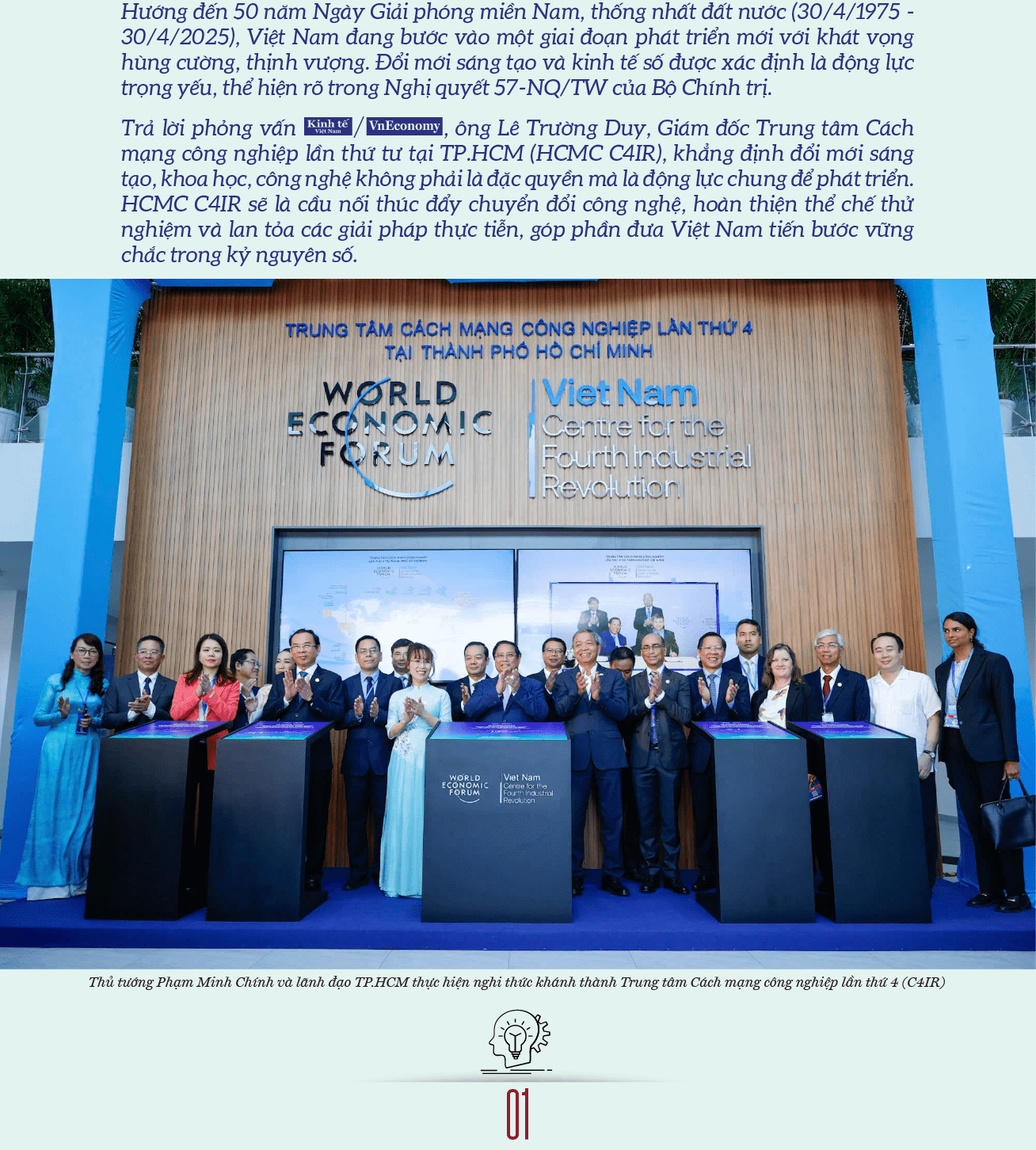
Speaking at a side event of Davos 2025, Prime Minister Pham Minh Chinh said that establishing the Centre for the Fourth Industrial Revolution in Ho Chi Minh City is fully in line with policy and actively contributes to implementing the Politburo’s Resolution 57 on breakthroughs in science, technology, innovation and digital transformation. He expressed the hope that HCMC C4IR would become a core of innovation, developing in a manner worthy of Ho Chi Minh City and of relations between the WEF and Viet Nam in general and Ho Chi Minh City in particular; that it would promote and spread the positive influence of the WEF, the community of 24 Centres for the Fourth Industrial Revolution worldwide and innovation centres of other countries; and that it would help address the issues facing Viet Nam, the region and the world, with Ho Chi Minh City as the pioneering locality in research and implementation.
HCMC C4IR’s participation in the WEF’s C4IR network is especially important, allowing Viet Nam to engage with and move alongside advanced countries in shaping the Fourth Industrial Revolution that is unfolding rapidly on a global scale. Through the WEF’s C4IR network, HCMC C4IR can access and draw on the WEF’s ideas, frameworks, initiatives and resources, helping Viet Nam shape and quickly and effectively implement initiatives in science, technology, innovation and digital transformation in the context of integration and globalisation.
In addition, HCMC C4IR promotes technology cooperation between Viet Nam, Ho Chi Minh City and international partners, and studies new technology trends through the global C4IR network, the World Economic Forum, innovation centres of other countries and the domestic and international business community, so as to advise the city and the country on policy.
How do you assess the progress and challenges of digital transformation in Viet Nam today, especially in the public sector? Ensuring cybersecurity during digital transformation is a major concern. What support does the Centre provide in building a safe and trusted digital transformation ecosystem?
In recent years, the Party and the State have promptly issued sound and well-targeted guidelines and policies to proactively engage with the Fourth Industrial Revolution, promote digital transformation and develop the digital economy. As a result, digital transformation and the digital economy have achieved important results. Viet Nam’s digital economy growth rate is the highest in Southeast Asia and consistently among the top in the region and the world.
However, overall, digital transformation, especially in the public sector, has not yet met requirements or fully played its role in leading and enabling national digital transformation and driving the digital economy. The main challenges lie in integrating, synchronising and sharing data across ministries, sectors and localities, and in the lack of open data resources to support data-driven innovation in the community and society, which would in turn drive digital transformation and the digital economy.
At the same time, cybersecurity is an indispensable pillar for building a trusted digital economy. It is an area of particular interest to the WEF and the C4IR network, which have specific initiatives on it. HCMC C4IR will also draw on the WEF’s frameworks, policies and resources to make suitable policy recommendations for Viet Nam in the period ahead.

Regulatory sandboxes are seen as a “launch pad” for innovation and for creating many new, breakthrough business models in many countries. However, sandboxes in Viet Nam, especially in new fields such as digital finance and blockchain, are still approached cautiously. How will HCMC C4IR address these limitations? Which areas do you think HCMC C4IR will propose and develop policies for first, so they can be piloted quickly?
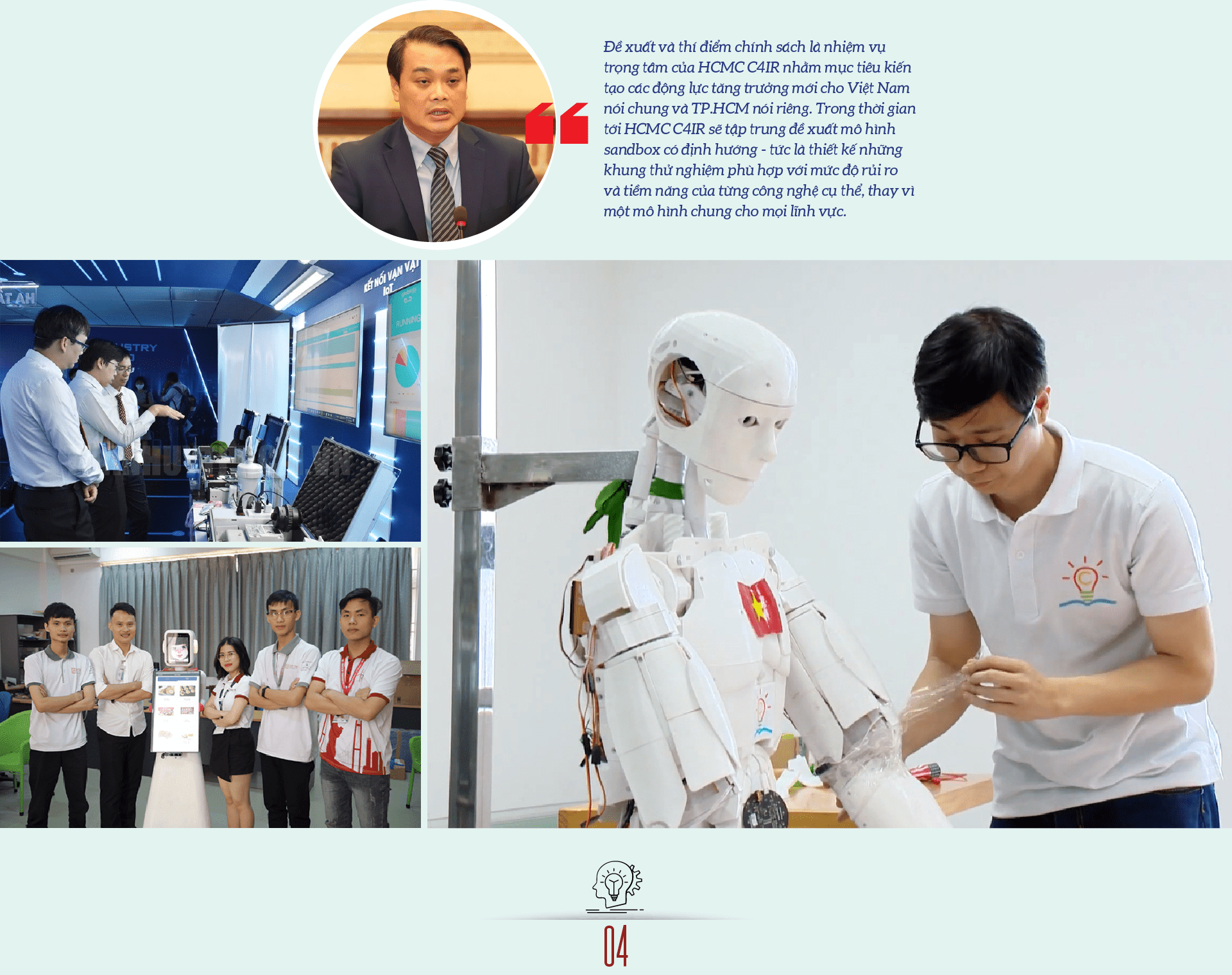
Proposing and piloting policies is a core task of HCMC C4IR, aimed at creating new growth drivers for Viet Nam in general and Ho Chi Minh City in particular. In the coming period, HCMC C4IR will focus on proposing a targeted sandbox model, that is, designing testing frameworks suited to the level of risk and potential of each specific technology, rather than a single model for all fields. At the same time, we are working closely with Ho Chi Minh City’s state management agencies to build a flexible coordination mechanism between regulators, businesses and innovation organisations.
In terms of priorities, we are currently researching sandbox proposals in 4 key areas.
First, digital finance, including digital banking models, integrated financial services on digital platforms and technology solutions such as e-KYC and AI-based credit scoring.
Second, applied blockchain: not only in finance, but also in supply chains, land management and traceability of agricultural products, where transparency and immutability are essential.
Third, artificial intelligence (AI): especially AI in healthcare, education and public administration, where effectiveness and social impact need to be tested before scaling up, including piloting AI applications such as virtual assistants to support the city’s socio-economic management.
Fourth, the green economy and circular economy, a promising new group of fields that requires unprecedented technology solutions, where sandboxes will play an important role in creating a “safe space” for innovation.
We believe that, if implemented in the right way and at the right time, sandboxes will not only remove barriers for breakthrough business models but also lay an important foundation for building institutions suited to the digital economy and innovation in the long term.
In your view, is innovation today the “privilege” of large corporations and tech startups? How can a spirit of innovation be fostered in the public sector, traditional industries and local communities? Does the Centre have a specific strategy to take innovation beyond “workshops and seminars” and into the operations of businesses and state management?
I do not think so. In fact, large corporations and tech startups have played a very important role in recent years; they are an important resource and driving force for promoting and spreading research and application of science, technology and innovation. Innovation can come from anywhere. The question is how we change our thinking about innovation, linking it not only to complex technology but also to how we improve processes and business models and solve practical problems in daily life.
At HCMC C4IR, we are working to bring an innovation mindset closer to all segments of society. We want to create practical programmes and projects that can change lives, with particular attention to cooperation between the public sector and businesses, and to promoting international cooperation for both. To that end, we are working with relevant agencies to roll out pilot models, not stopping at small initiatives but developing solutions that can be scaled up and applied more widely.
I believe that to make innovation part of Viet Nam’s development culture through an integrated mindset, we must make it more accessible and practical. Innovation will then become an essential part of every field, from the public sector to traditional industries, from large cities to local communities, with large corporations and startups accompanying and leading the community.