
Identifying bottlenecks in digital transformation and innovation
Reviewing the first months of the year, the head of Government acknowledged many positive changes in science, technology, innovation and digital transformation. However, the Prime Minister also frankly pointed out the bottlenecks still holding back progress.
Specifically, mechanisms and policies remain fragmented and overlapping. In particular, the lack of detailed guidance on controlled testing mechanisms (sandboxes) and research commissioning mechanisms is slowing innovation. In addition, progress in building and connecting sectoral databases has not met the “accurate, complete, clean, live” criteria, and the data has not been shared effectively. Cutting administrative procedures and rolling out online public services still face many limitations.
The Prime Minister stressed: “The spirit is to act effectively and substantively, never as a formality or for show”. He also required heads of ministries, sectors and localities to direct the work personally and be accountable. Results in implementing Resolution 57 and Project 06 will be used as core criteria to assess leaders’ performance in 2026.

Focusing on digital infrastructure and unlocking research resources
On strategic direction going forward, the Government leader called for integrated development of digital infrastructure and comprehensive digital transformation. Ensuring seamless data connection and sharing is key to improving governance and making things as easy as possible for citizens and businesses. The data economy and artificial intelligence (AI) are identified as the core focus of national digital transformation.
To ensure that strategic technologies deliver concrete results in 2026, the Prime Minister called for strongly promoting the “State – Research Institutes – Universities – Businesses” cooperation model to unlock resources for research, development and technology commercialisation.
He directed a rapid shift from fragmented research to commissioning based on major national challenges, ensuring concrete products and markets, and the application of special financial mechanisms that accept controlled risk in scientific research.
Specific tasks for ministries and sectors
To remove institutional obstacles, the Prime Minister assigned a series of key tasks with specific deadlines to the relevant ministries and sectors:
- Ministry of Science and Technology: Lead and coordinate with the Ministry of Finance to develop mechanisms for commissioning, assigning and accepting science and technology products based on outputs (report in July). In June, issue economic and technical norms and mechanisms for pricing, procurement and service leasing for internal software and digital data. It must also provide guidance on identifying major challenges suited to each sector’s potential; upgrade and share key laboratories; and work with the Ministry of Construction on standards for high-speed rail.
- Ministry of Finance: Responsible for guiding budget spending mechanisms for strategic technology products and pilot products.
- Ministry of Public Security: Focus on bringing the National Data Centre into operation in June to provide seamless digital infrastructure for ministries, sectors and localities.

Positive signals in the digital transformation picture
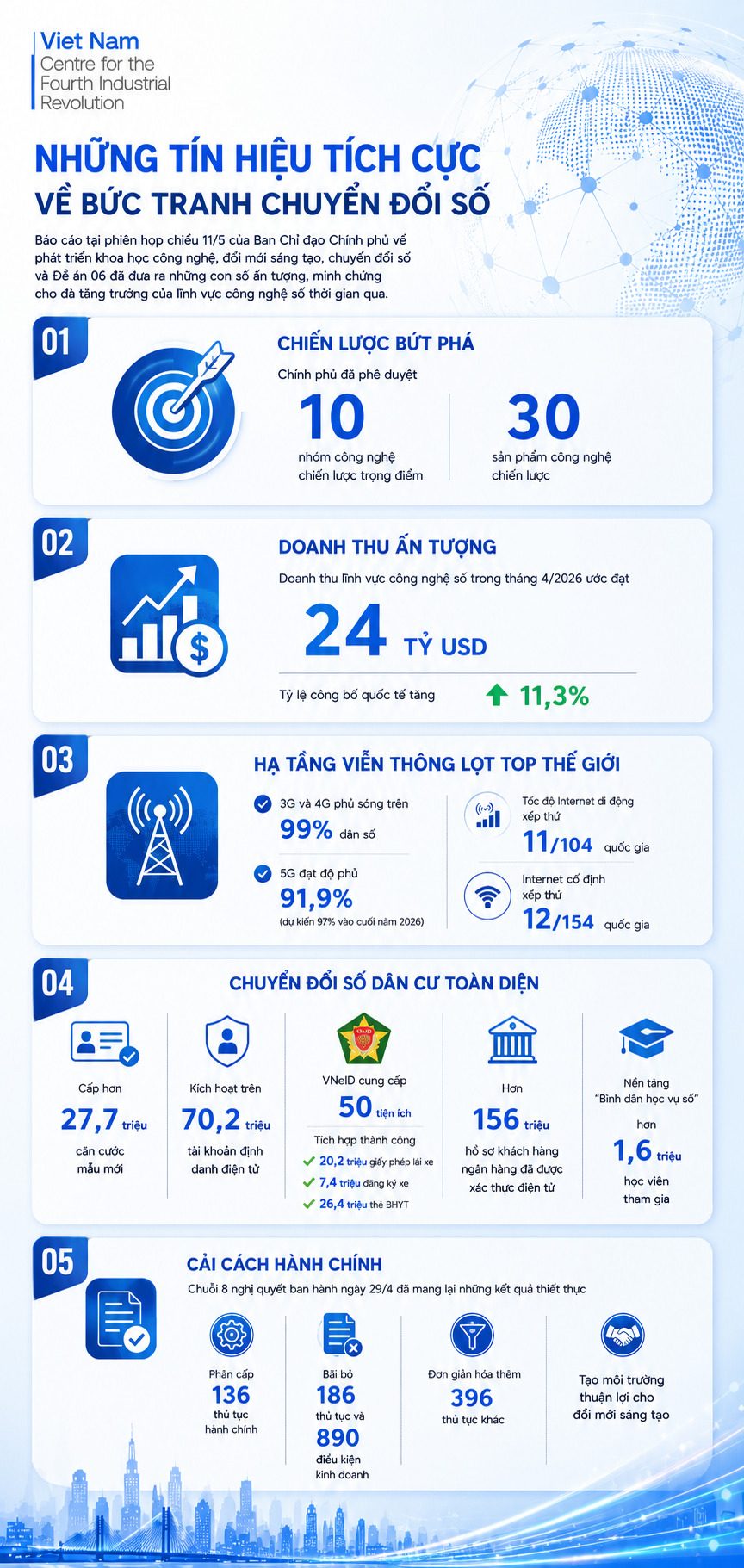
The report at the meeting presented impressive figures demonstrating the growth momentum of the digital technology sector:
- Breakthrough strategy: The Government has approved 10 key strategic technology groups and 30 strategic technology products.
- Impressive revenue: Digital technology sector revenue in April 2026 is estimated at USD 24 billion. International publications rose 11.3%.
- World-class telecom infrastructure: 3G and 4G networks cover more than 99% of the population; 5G coverage has reached 91.9% (expected to rise to 97% by the end of 2026). Viet Nam’s mobile Internet speed now ranks 11th of 104 countries, while fixed Internet ranks 12th of 154.
- Comprehensive digital transformation for citizens: More than 27.7 million new-format ID cards have been issued and over 70.2 million electronic identification accounts activated. The VNeID platform now offers 50 services and has integrated 20.2 million driving licences, 7.4 million vehicle registrations and 26.4 million health insurance cards. More than 156 million bank customer records have been electronically verified; the “Digital literacy for all” platform has attracted more than 1.6 million learners.
- Administrative reform: A series of 8 resolutions issued on 29 April decentralised 136 administrative procedures, abolished 186 procedures and 890 business conditions, and simplified a further 396 procedures, creating a favourable environment for innovation.