
- In most countries, television, print and websites are becoming less popular, according to a report from the Reuters Institute.
- Social media and video are fast becoming news sources, with podcasts and AI as emerging trends.
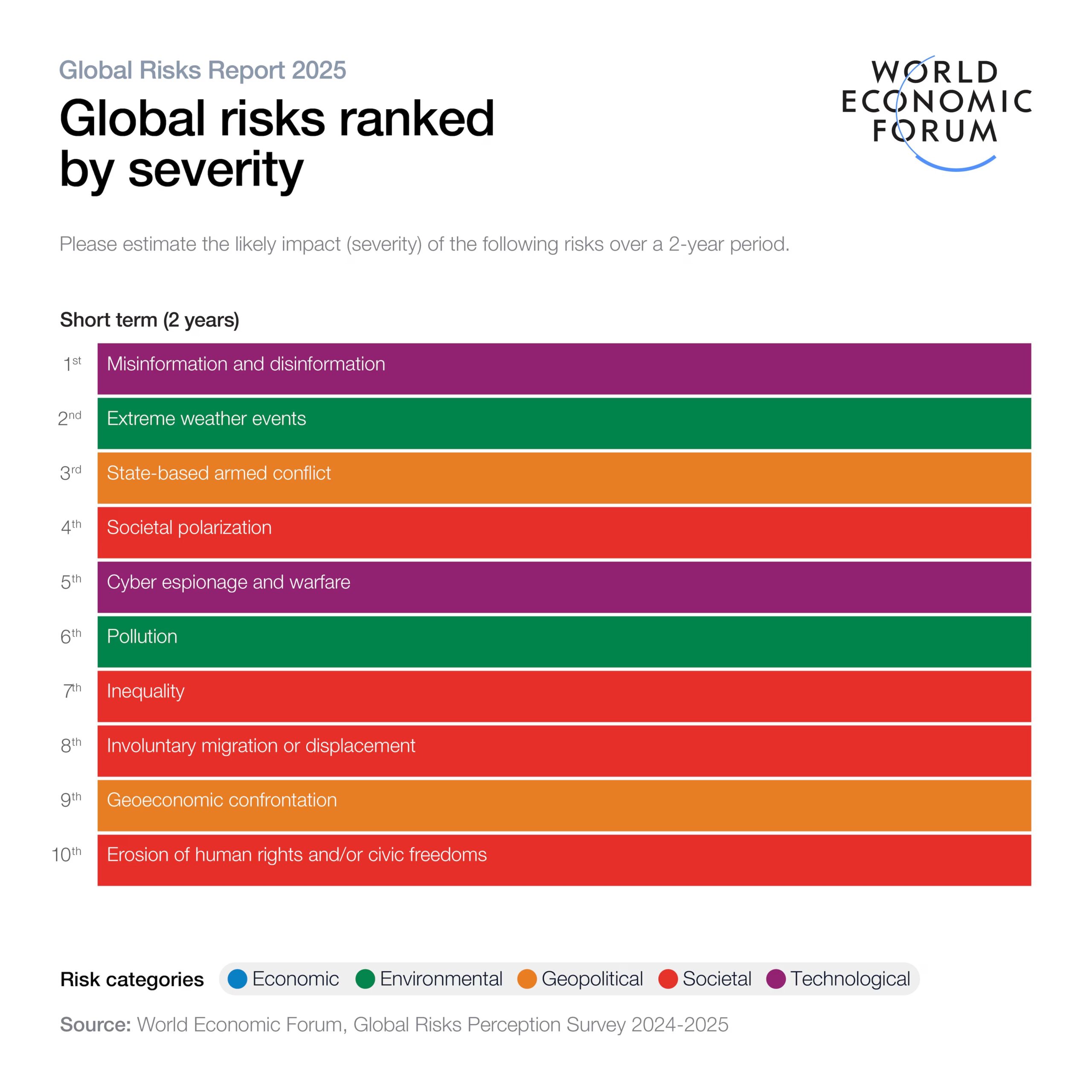
- The public is concerned about what these new trends mean for misinformation, the top short-term risk according to the World Economic Forum’s Global Risks Report 2025.
How do people keep up with the world today? In most countries, television, print and websites are becoming less popular, according to a report from the Reuters Institute.
The Digital News Report 2025, which distils data from six continents and 48 markets, finds that these traditional media are struggling to connect with the public, with declining engagement, low trust and stagnating subscriptions.
So where are people getting their news in 2025? And how might these changes have an impact?
The rise of social media and video
Amid political and economic instability, the climate crisis and ongoing conflicts around the world, there is certainly no shortage of stories to report. But audiences continue to turn to new places for information, namely social media, video platforms and online news aggregators.
The use of social media for news is rising in many countries, though more markedly in the United States, Latin America, Africa and some Southeast Asian countries. In the United States, for example, the share of people who say social media is their main source of news has risen significantly over the past decade, from around 4% in 2015 to 34% in 2025. For the first time, the share of people in the US accessing news via social media and video platforms has overtaken both television and news websites.
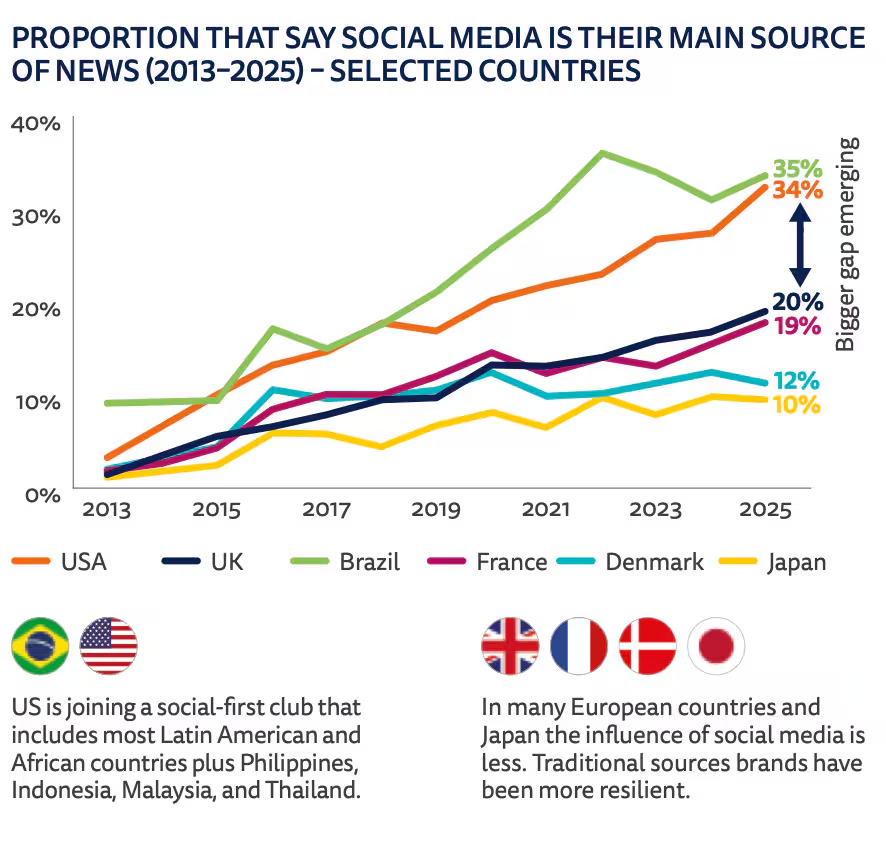
In many European countries, traditional news sources remain more resilient, but the use of social media for news is still growing. In the United Kingdom and France, for example, around a fifth of the population in each country now uses social media as a main source of news, compared with less than 10% a decade ago.
Across all the markets studied in the report, video consumption continues to grow. Reliance on social media and video platforms for news is highest among younger age groups: 44% of 18 to 24-year-olds and 38% of 25 to 34-year-olds say these are their main sources of news.
Emerging trends: podcasts and AI
The report highlights two emerging themes. The first is the use of a so-called “alternative media ecosystem”, in which people increasingly get their news from podcasters and creators on networks such as YouTube and TikTok, the fastest-growing social media and video platforms.
In some countries, influencers and personalities now play an important role in shaping public debate. In the United States, for example, news and commentary from podcaster Joe Rogan reach a fifth of the population. In France, 22% of under-35s watch content from news creator Hugo Travers, mainly via YouTube and TikTok.
Young influencers are also playing a significant role in many Asian countries, the report says.
The second emerging theme highlighted by the report is the use of artificial intelligence (AI) chatbots as a source of news, as search engines and other platforms begin to integrate real-time news into their products. Currently 7% of people get news this way each week; the figure is still small but rises to 15% among under-25s.
The risk of misinformation
Overall, trust in news remains stable at 40%, according to the report. But around the world, the public is concerned about the impact of changes in how news is accessed.
Although optimistic about some of the benefits AI brings to news, such as summarising or translating content, people remain sceptical about its use, believing it will make news less transparent, accurate and trustworthy. Many also worry about missing important stories.
Meanwhile, online influencers and personalities are also seen as potential sources of false or misleading information. This is consistent with the World Economic Forum’s latest Global Risks Report, which identifies misinformation and disinformation as the most pressing risks over the next two years.
More than half of those surveyed in the Reuters report said they are worried about being unable to tell what is real and what is fake in online news. Trusted news brands are where people turn most often when they want to check whether a story is true.
Digital literacy and responsible use of AI
According to the Forum’s Global Risks Report, the growing use of digital platforms and the increasing volume of AI-generated content are making divisive misinformation and disinformation more widespread. This helps amplify other risks the world faces, from state-based armed conflict to extreme weather events.
Ultimately, the report says, this is making it increasingly difficult to identify reliable sources of information.
The report recommends that governments, businesses and civil society organisations develop awareness programmes and digital literacy initiatives to help people understand the risks of the digital space and be able to recognise and challenge harmful or biased content.
Improving accountability and transparency frameworks for AI will also be part of the solution.
Source: WEF