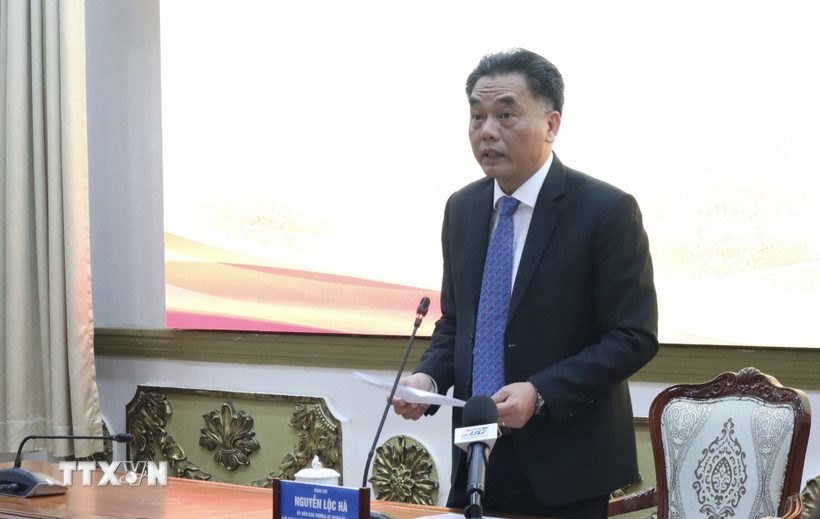
The Ho Chi Minh City People’s Committee held the conference “Outstanding overseas Vietnamese accompanying the City’s green transition in the digital era” on 6 February.
Many overseas Vietnamese intellectuals, experts and entrepreneurs proposed strategic solutions to help the City make breakthroughs in green transition, digital transformation and innovation.
The overseas Vietnamese community is an important resource
Mr Nguyen Loc Ha, Standing Vice Chairman of the Ho Chi Minh City People’s Committee, said 2025 marked a historic milestone as the City merged administratively with Binh Duong and Ba Ria-Vung Tau provinces, forming an integrated megacity of more than 6,700 km2 with a population of over 14 million.
The merger not only expands development space but also creates synergy among strategic advantages, connecting the financial, services and science and technology centre with the industry, logistics and marine economy of the southern region, while setting new requirements for the development model and governance capacity.
On that basis, the City has established an overall development model of “3 regions – 1 special zone – 3 corridors – 5 pillars” as a long-term strategic framework for attracting investment and developing infrastructure, the green economy, the digital economy and innovation at regional and international level.
In 2026, the first year of implementing the Resolution of the City Party Congress for 2025-2030, the City regards green transition, digital transformation and innovation not only as strategic choices but as the inevitable path to raise competitiveness and achieve sustainable development.
The overseas Vietnamese community is identified as one of the City’s important strategic resources. More than 3 million people originating from the City live in over 130 countries and territories; remittances to the City in 2025 are estimated at about USD 10.5 billion.
The greatest value of overseas Vietnamese lies not only in financial resources but in knowledge, management experience, technology and the ability to connect with global networks.
The City hopes that overseas Vietnamese intellectuals, experts and entrepreneurs will engage even more deeply in policy advice, knowledge and technology transfer, investment connection and expanding international markets.
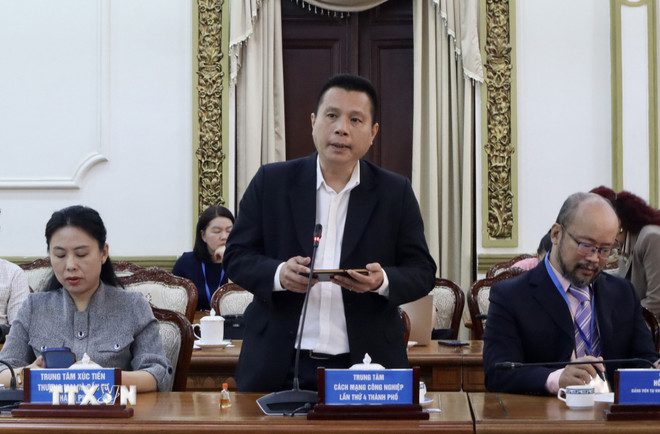
Mr Nguyen Duc Huy, Deputy Director of the Centre for the Fourth Industrial Revolution (C4IR), said 2025-2026 is seen as a period of acceleration for the twin green and digital transition worldwide.
In the green and circular economy, technologies such as IoT, artificial intelligence and automation are becoming important tools for monitoring emissions, managing energy, optimising resource use and treating waste in real time.
These solutions help achieve emission reduction targets towards Net Zero. The green-digital transition is not just a technology story; it requires coherent institutions, governance capacity, mechanisms for piloting and scaling models, and safeguards for data security and cybersecurity.
The main challenge today is not a lack of technology but a lack of effective mechanisms connecting international knowledge with domestic development needs. The overseas Vietnamese community, with its expertise, international experience and global networks, is therefore seen as an especially important resource.
Mr Nguyen Duc Huy proposed focusing on the role of overseas Vietnamese in four areas: policy advice and transfer of modern management knowledge; connecting and transferring core technologies and breakthrough solutions for the green-digital transition; helping create new financial mechanisms for science, technology and innovation; and supporting the training and development of high-quality human resources.
Ideas to help the City rise
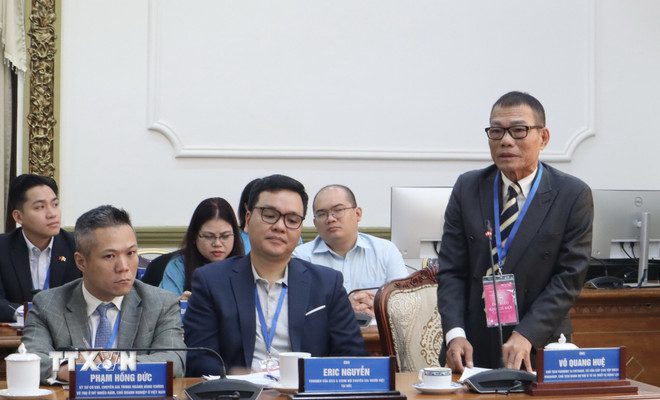
Speaking from a business and innovation perspective, Mr Vo Quang Hue, Chairman of FoundryAI Vietnam and Senior Adviser to Vingroup, emphasised that the knowledge of the overseas Vietnamese community is not an abstract concept but a living resource that can create real impact if properly connected and harnessed.
This is especially important as Ho Chi Minh City takes on pioneering development tasks, from being the country’s growth engine to leading the green transition, digital transformation and innovation.
The City’s development challenge today is not only capital or infrastructure, but first and foremost people, knowledge, technology and governance capacity. The overseas Vietnamese community is a resource especially well suited to the City’s new development tasks.
The greatest value of overseas Vietnamese lies not only in remittances but in technological knowledge, management experience, understanding of international institutions and standards, and the ability to connect Viet Nam, and Ho Chi Minh City in particular, with global knowledge, business and policy networks.
Experience shows that when there is a “big enough challenge” and the right environment, overseas Vietnamese intellectuals are ready to engage substantively and for the long term.
The City needs to move from an event-based approach to a systematic approach in connecting with overseas Vietnamese, by forming expert networks by field and inviting them to advise on policy, especially in artificial intelligence, digital transformation and green transition.
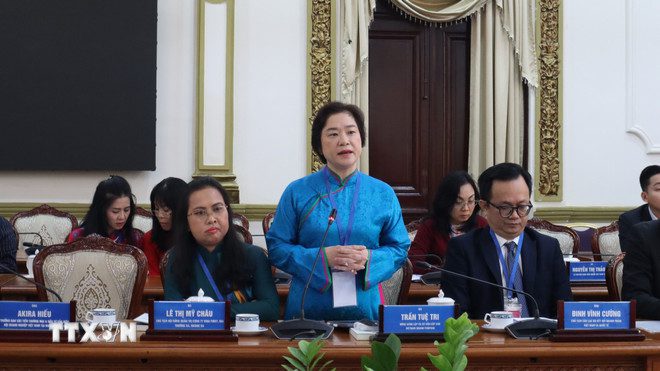
The City should study flexible residence and work mechanisms to attract, retain and make effective use of overseas Vietnamese intellectual resources, Mr Vo Quang Hue proposed.
Mr Eric Nguyen, founder of IECS & ISemi and representative of the Association of Vietnamese Experts in Germany, said the twin green-digital transition is vital if Ho Chi Minh City wants to escape the middle-income trap.
The City cannot be content with being a processing hub or stopping at administrative digital transformation; it must pursue digital transformation alongside building engineering capacity, moving from “knowing how to use” to “mastering and creating technology”.
Without the pillar of technological mastery, Ho Chi Minh City will remain a market that consumes technology rather than a place that creates value.
Germany’s experience shows a development model based not mainly on large consumer technology groups but on a system of small and medium-sized enterprises with core capabilities in design, precision manufacturing, energy and foundational industries.
As artificial intelligence develops rapidly, software can be automated, but engineering depth and manufacturing capacity remain the “fortress” protecting the economy’s competitiveness.
Mr Eric Nguyen outlined two strategic directions the City can apply to build a solid foundation for long-term growth.
First, build an elite engineering centre for Ho Chi Minh City under a public-private partnership model, linking the State, technology businesses and universities.
This centre would not only help address the shortage of high-quality research and development staff but also close the gap between training and practice, allowing students to work directly on technology projects during their studies.
This model has proven effective in many countries and could be piloted at the Ho Chi Minh City Hi-Tech Park with the participation of the network of overseas Vietnamese experts.
Second, pilot a mechanism for sharing and using public data for innovation. Urban data is currently scattered across agencies, wasting resources and limiting the growth of technology businesses.
Establishing an intermediary mechanism to manage and share safely processed data would enable businesses to research and develop solutions for transport, healthcare, planning and urban management, while adding value for the public sector.
According to Mr Eric Nguyen, what matters is not financial incentives but “unshackling” pilot mechanisms. When the City is ready to open the way, the overseas Vietnamese expert community is ready to contribute knowledge and management experience and take a direct part in the City’s major challenges, even remotely.
Instead of large-scale projects on paper, the City can start with small but high-quality pilot programmes and scale them up step by step.
With open policies, a systematic approach and the substantive engagement of the overseas Vietnamese community, the City has every basis to make effective use of global intellectual resources and rise to become a green, smart city and a regional centre of innovation and engineering in the digital era.
By Xuan Anh/VNA