
In the era of the Fourth Industrial Revolution, building an AI ecosystem is not only a task for Big Tech; it also requires domestic telecom groups to step up and master connectivity infrastructure, edge computing and data governance, laying a solid foundation for a self-reliant and sustainable digital economy.
Telecom companies are key drivers of the digital economy, yet in practice they capture only a small share of the value created. Today, artificial intelligence (AI) and geopolitical shifts are driving a redistribution of where data is stored, computing capacity and user trust. This is redefining the position of telecom operators in the ever-changing AI era.
To offer a strategic lens for policymakers and business leaders, the World Economic Forum (WEF) has published the report “The Strategic Role of Telecom Providers Across the AI Value Chain”. The paper not only addresses operational optimisation but also sets out a broad vision: how communication service providers (CSPs) can transform from simple connectivity providers into “architects” of the global AI economy.
Context: a structural turning point for the telecom industry
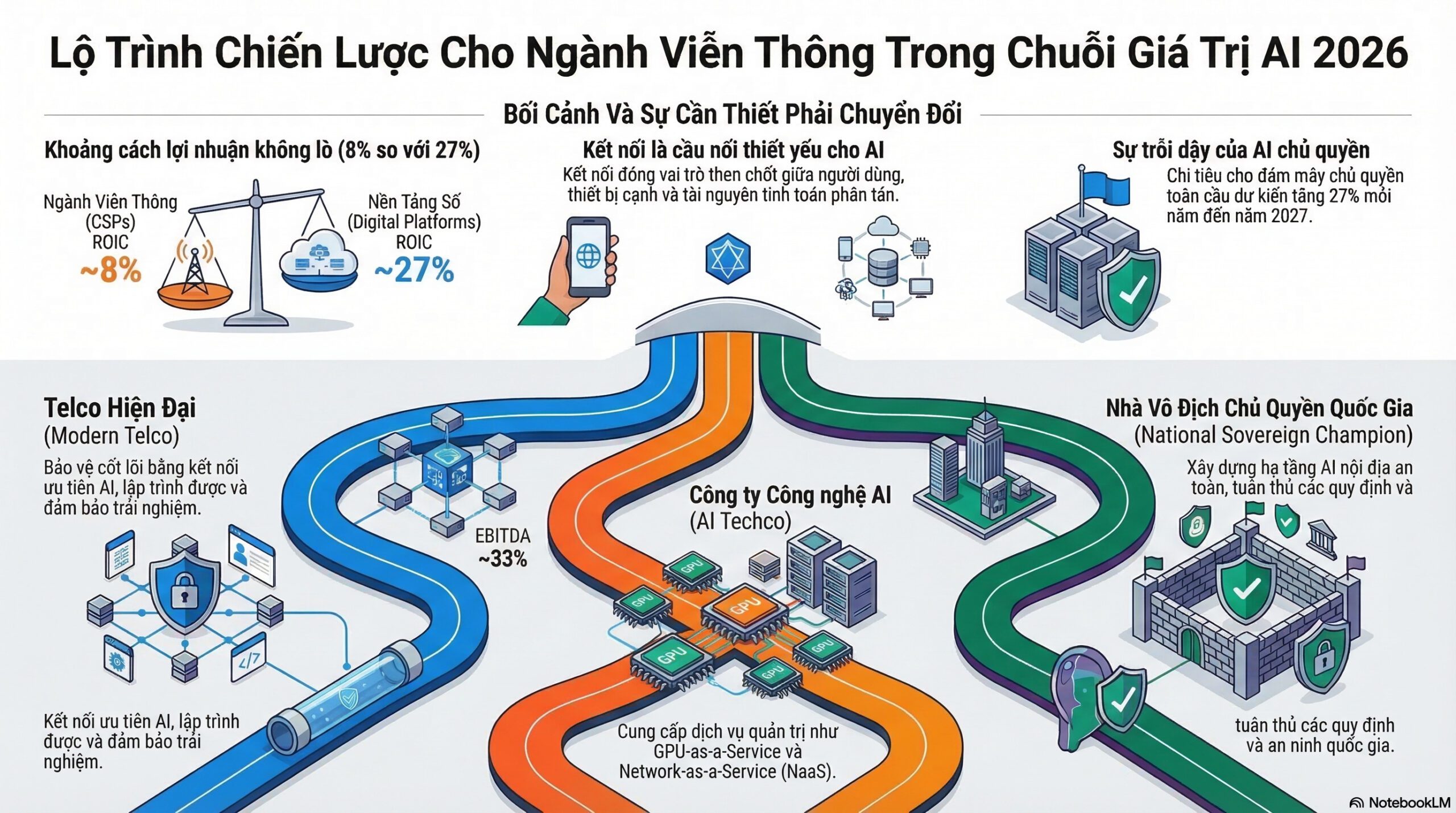
Over the past three decades, telecom companies built the core infrastructure of the digital economy, yet captured only a small share of commercial value compared with hyperscalers. The global telecom industry’s margins are expected to hover around 33%, with after-tax return on invested capital (ROIC) of 8% in 2025, far behind the 27% of digital platforms.
However, the AI boom and geopolitical shifts are reshaping the global technology architecture. At the heart of this shift are data location, computing power and trust. Network infrastructure must now move from best-effort data delivery to programmable, AI-first connectivity with ultra-low latency to support complex workloads such as agentic AI and multimodal AI.
Three strategic pathways shaping the future
Rather than treating AI as a tool for internal cost optimisation, the WEF report outlines three high-level strategic pathways for operators to capture the AI value chain:
1. The Modern Telco – protecting and elevating core value:
This pathway focuses on modernising network architecture into a cloud- and AI-first format. Its strategic levers include:
- AI-first connectivity: Providing predictable performance through network slicing and standardised APIs, ensuring quality of service (QoS) for real-time AI workloads.
- Data Centre Interconnect (DCI): Providing high-capacity, low-latency optical transport to link hyperscale and edge data centres for distributed AI training and inference.
- Private networks and AI-optimised storage: Integrating edge computing with private 5G connectivity for industrial automation and critical infrastructure.
2. The AI Techco: Growth through managed services
This is a step beyond traditional connectivity into the computing and platform services layer.
Telecom providers can offer
Network as a Service (NaaS), combined with advanced automation to deliver flexible, demand-based networks.
Seizing the opportunity created by the scarcity of computing power, CSPs can offer GPU as a Service (GPUaaS), giving businesses access to shared GPU clusters in low-latency edge data centres.
In addition, offering vertical AI solutions (for manufacturing, healthcare and finance) will connect industry expertise with seamless network infrastructure.
3. The National Sovereign Champion: Enabling digital resilience
As countries and highly regulated industries place growing emphasis on data sovereignty, the third pathway positions operators at the centre of the “national AI ecosystem”.
CSPs will operate sovereign AI infrastructure, ensuring that data and AI training and inference processes (LLMs) are kept entirely within national borders.
Offering sovereign AI platforms and model services, combined with an AI safety and security layer, helps maintain compliance with strict data regulations (such as GDPR or domestic data laws).
A framework for assessing capability and feasibility
To put these strategies into practice, the WEF provides a Value–Feasibility Matrix. The report finds that sovereign AI infrastructure and vertical AI solutions deliver the highest value (large ROI) but require deep technological capability, significant capital investment and strong coordination with the ecosystem.
Success in this transformation requires enablers at two levels: foundational (data governance, security, AI strategy) and pathway-specific (infrastructure capacity, operating models, public-private partnerships).
Full white paper “The Strategic Role of Telecom Providers Across the AI Value Chain”