


To see the impact of this convergence, consider two ways the same engineer might work on the same production line:
-
Reactive operations: A machine has been silently reporting a fault since 3 a.m. The engineer spends 20 minutes extracting historical data and another hour finding a fix. Even so, quality control later finds that the sample batch does not meet standards. As a result, the plant has to scrap the whole batch, restart the testing cycle from scratch and accept a delayed product launch.
-
Proactive operations: By the time the engineer starts the shift, the machine has already been serviced. Its digital twin automatically detected signs of declining performance hours earlier and triggered predictive maintenance. Meanwhile, the engineer uses a simulation model to fine-tune parameters for the new batch, ensuring output quality. Real data is then continuously compared with the digital platform to optimise operating time for subsequent cycles.
Same person, same factory, same equipment. The difference lies in the state of the system: one is chasing problems, the other anticipates and controls risk. The core factor behind this shift is not a standalone tool, but the result of technology convergence.
Technology convergence and the new logic of competition
According to the World Economic Forum (WEF) report Technology Convergence: The New Logic for Competitive Advantage, the answer does not lie in any single technology. It lies at the intersection of three seemingly independent elements: industrial hardware, sensor systems and edge AI. When they converge, they create an entirely new capability: capturing highly accurate data and feeding it straight into a system that operates in real time.
This is the essence of technology convergence, the force quietly rewriting the rules of competition in every industry.
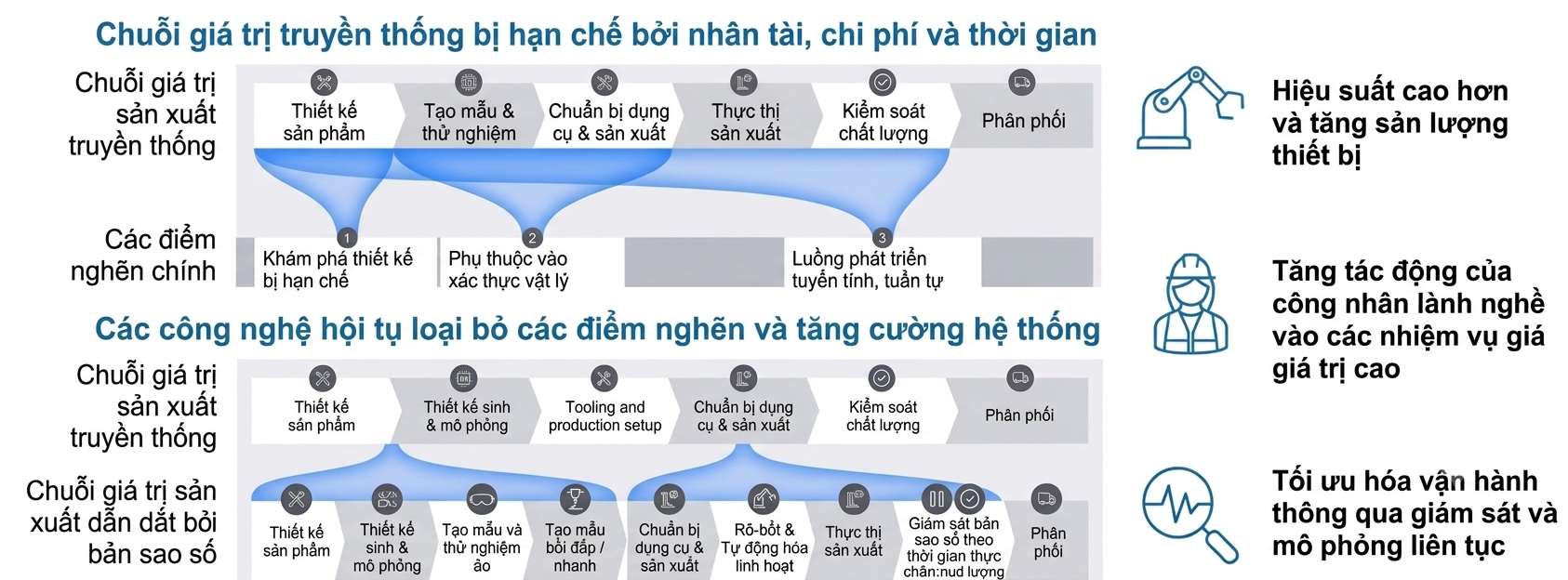
In essence, every industry is organised around inherent bottlenecks: scarcity, latency, high cost or high risk. For decades, businesses learned to optimise around these bottlenecks, even building business models on the assumption that they were fixed. But the bottlenecks are shifting, and the drivers do not necessarily come from within the industry.
In manufacturing, the biggest bottleneck has always been the cost and speed of physical prototyping: every round of testing consumes money, time and materials. As 3D printing and printed electronics mature and integrate deeply with simulation software, three previously separate fields, hardware fabrication, component manufacturing and software programming, begin to converge.
The bottleneck does not disappear; it shifts from “expensive physical prototyping” to “managing integrated digital-physical simulation systems” and, more importantly, to the adaptability of the workforce itself. The challenge then lies not in technological capability, but in how fast people can adapt to that convergence.
This is not unique to manufacturing. The WEF report notes similar patterns in other industries. For example, robotic surgery becomes feasible when new materials, AI and spatial computing converge at the same time; and drug discovery is significantly shortened when AI is combined with robotics and data systems. All these phenomena share one thing: they do not come from a single technology, but from technologies combined in a systematic way.
Why linear intuition no longer works
The biggest challenge for business owners today is not the arrival of a new technology. New technologies come with press releases and scientific conferences and are not hard to follow. The difficulty lies in combinations of two or three seemingly unrelated technologies that quietly integrate to create a breakthrough capability outside the usual field of view.
Following the evolution of one technology is like watching an arrow fly in a straight, predictable line. Technology convergence is many arrows flying from different directions. The decisive point is where they intersect, a coordinate that remains invisible if the observer follows each trajectory separately. That is why the WEF proposes a visual strategic solution: technology mapping.
Wardley Maps: from strategic thinking to a map of technology competition
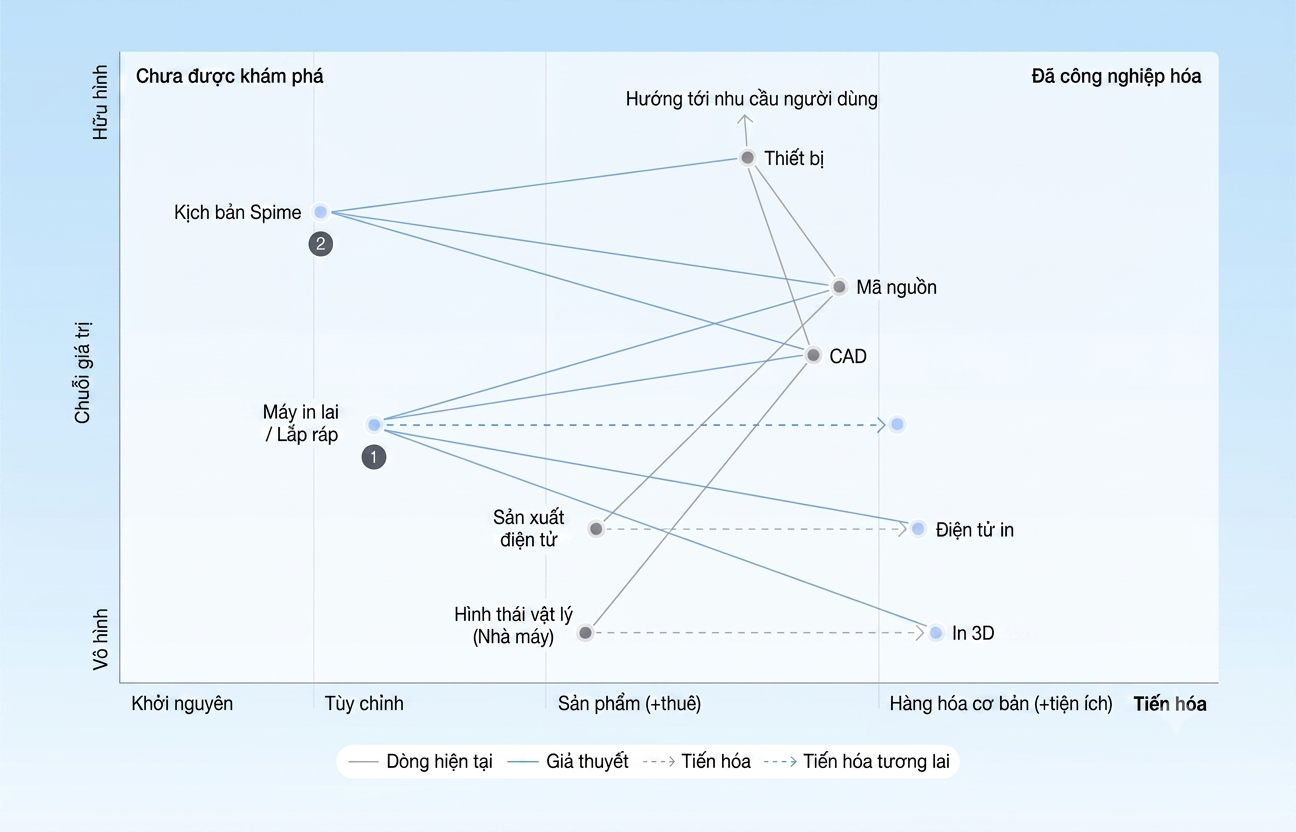
Image: Wardley Maps
The WEF report draws on Wardley Maps, a strategic mapping method developed by Simon Wardley that helps organisations see a complex system as a competitive landscape rather than a list of disconnected tasks. The map is built on two visual axes: user needs at the top, the technology components that meet those needs below, and a horizontal axis showing maturity, from a vague, uncertain idea to an industrialised, commoditised capability that anyone can use at low cost.
Vertical axis (value chain): User needs are placed at the top. The technology components meeting those needs sit below according to their level of dependency.
Horizontal axis (evolution): Shows how a technology matures, moving from early ideas and custom builds to commercial products and finally to commodity utilities at very low cost.
The greatest value of Wardley Maps does not lie in perfectly accurate forecasting like a financial report. Its practical value is that it forces leaders to see the gaps where two or three technology trajectories are converging along the evolution axis, even if today they still belong to separate departments.
In the manufacturing example, a dotted line traces a clear path of convergence: from 3D printing and printed electronics to hybrid manufacturing, then “compiled manufacturing”, and further to programmable “cyber-physical” production. There, a product is no longer just an inert object but a set of instructions that can be compiled directly into a physical entity. The same pattern is emerging in key industries: semiconductors, biomedicine, renewable energy and digital finance.
Three practical benefits of technology mapping
First, spotting breakthrough combinations early. By placing technology domains, including AI, spatial computing, advanced materials, robotics, quantum computing and biotechnology, on the same coordinate system, business owners can see which platforms are mature enough to “bridge” into new capabilities. The leader’s advantage comes not from owning more powerful technology, but from seeing the intersection earlier than competitors.
Second, demystifying technological “miracles”. From the outside, many breakthroughs look like random leaps. But on an evolution map, they follow strict patterns: the maturing of core components, commoditisation that lowers costs, the breaking of bottlenecks and shifts in the partner ecosystem. Understanding these patterns helps businesses proactively plan their strategic timing rather than passively waiting for breakthroughs.
Third, optimising investment decisions and resource allocation. An accurate map answers a practical question: which technologies should be built, bought, outsourced, or fully exploited before they become commoditised? These decisions are easily swayed by gut feeling or short-term financial pressure. Placed on a map, they become options with clear, testable logic.
Moreover, mapping is a neutral communication tool. When the map is laid out on the meeting table, it removes turf battles between departmental silos. Discussion focuses on the position and trajectory of components on the map rather than clashes of personal ego.
The trap of “wait and see”
A common psychological trap in management is to treat technology convergence as a future trend, something business owners file under “later”. The WEF report says this is a fatal mistake. Technology convergence is a strategic challenge that exists now. The only difference is whether the organisation tackles it proactively or lets it reorganise the market to its disadvantage.
For example, 3D printing is changing the rules of manufacturing, even though it was once seen as a prototyping device in biochemistry labs, outside the sights of traditional mechanical engineers. The lesson for business owners is clear: a company’s technology watch list must never be confined to the boundaries of its current industry.
Of course, an organisation’s first technology map is never perfect, and it does not need to be. Its value lies in the act of starting to draw, because the most uncertain and unclear areas of the map are often where a business’s next competitive advantage is hidden.
This article draws on the report “Technology Convergence: The New Logic for Competitive Advantage” published by the World Economic Forum with Capgemini (2026).