- First announced in 2015, the “Made in China 2025” (MIC2025) strategy set the direction and pace of China’s industrial ambitions.
- Today, the strategy is entering a new phase: a transformation built on artificial intelligence, green energy and self-reliance, aimed at restructuring what is widely regarded as the world’s most powerful industrial base.
- The question now is no longer whether China can innovate, but what kind of innovation ecosystem it is building, and how it may redefine global manufacturing.
Launched a decade ago, “Made in China 2025” was seen by many as a symbol of China’s far-reaching industrial ambition: a state-led roadmap to move the country from “the world’s factory” to a leading position in advanced manufacturing.
Although the slogan quietly disappeared from China’s official discourse under international scrutiny, the core programme behind it never went away. Instead, its goals evolved, were reframed under new slogans such as “dual circulation” and “high-quality development”, and eventually became embedded at the heart of China’s industrial strategy.
Today, that strategy appears to be entering a new phase, which might be called “Made in China 2.0”. While it has no official name, its outlines are becoming clearer: a transformation built on artificial intelligence, green energy and self-reliance, aimed at restructuring what is widely regarded as the world’s most powerful industrial base. From electric vehicles and solar panels to humanoid robots and enterprise-scale AI systems, China is reshaping the standards of competition.
This shift is taking place amid profound global change. Fragmented supply chains, rising techno-nationalism and concerns about overcapacity have created a volatile competitive environment for global manufacturing. Yet even in this uncertain context, China continues to expand its industrial and technological footprint. The question now is no longer whether China can innovate, but what kind of innovation ecosystem it is building, and whether that ecosystem could become an alternative to the liberal free-market model.
Made in China 2025: Progress and setbacks
When first announced in 2015, “Made in China 2025” (MIC2025) was framed as a blueprint for industrial transformation. Its goals were ambitious: reduce dependence on foreign technology and move China up the global value chain in ten strategic sectors, including semiconductors, advanced robotics, aerospace and biomedicine. Drawing heavily on Germany’s Industrie 4.0 initiative, MIC2025 promised to make China a global leader in high-tech manufacturing by the 100th anniversary of the founding of the People’s Republic of China in 2049.
Though often described as a detailed master plan for industry, MIC2025 was never really a specific policy blueprint. It lacked the level of detail of the industrial policies led by Japan’s Ministry of International Trade and Industry (MITI) in the 20th century. Instead, MIC2025 functioned as a directional roadmap, setting broad strategic goals and priority sectors, along with key performance indicators (KPIs) for local governments, Party officials and state-linked enterprises.
These KPIs, such as reaching certain domestic market shares in strategic technologies, became targets around which the bureaucracy mobilised. However, the plan offered little concrete guidance on implementation, leaving considerable room for interpretation, duplication and misalignment at provincial and municipal levels. In this sense, MIC2025 was less a tool for coordinating policy execution than a signalling device: announcing China’s industrial ambitions and setting the pace for resource allocation, political attention and institutional experimentation.
By some measures, MIC2025 has delivered. China now dominates key green technologies: more than 75% of global lithium-ion battery output, nearly 80% of solar panel output, and the majority of the world’s electric vehicle production. High-speed rail has become a showcase of China’s engineering capability. In robotics and sensor technology, rapid progress has narrowed the gap with global leaders.
However, the programme has also fallen short in key areas. Despite massive investment, China remains dependent on foreign technology for advanced semiconductors and critical high-tech components. Domestic development of biopharmaceuticals and next-generation aircraft still lags behind expectations.
According to assessments such as a recent Rhodium Group report, some of MIC2025’s shortcomings stem from systemic design flaws: duplicated investment across regions, misaligned local incentives, over-reliance on subsidies, and an excessive focus on the production side of the economy at the expense of household demand.
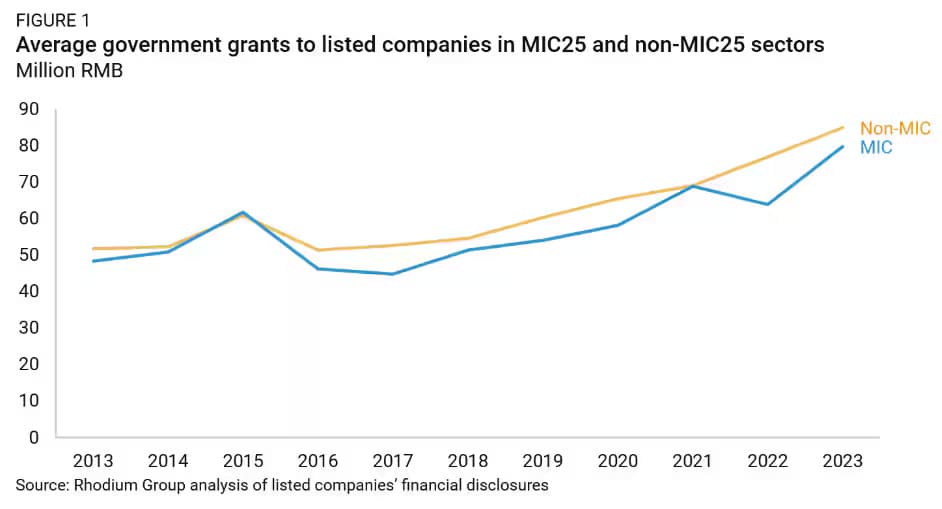
Moreover, the high-profile rollout of the programme attracted unwanted geopolitical scrutiny. It raised concerns in Washington and Brussels about state-led techno-mercantilism, leading to export controls and investment restrictions that now pose major barriers to China’s access to critical technologies. Although the “Made in China 2025” slogan has disappeared from official discourse, the strategic ambition behind it continues, often expressed in different forms.
Rather than viewing MIC2025 as a failed policy, it may be better understood as a catalytic phase: an initial framework that helped mobilise investment, drive industrial upgrading and shape a long-term vision. It established an industrial scaffolding that China has since refined and expanded, laying the groundwork for a new phase of development that is more distributed, networked and innovation-driven.
Compounding momentum in China’s industrial growth
One of the most striking features of China’s industrial rise is how its key sectors have become mutually reinforcing. As Princeton University researcher Kyle Chan has argued, China’s innovation system is not a collection of vertically separated sectors, but a network of overlapping, cross-pollinating ecosystems. Advances in one field, such as lithium batteries, create spillover benefits for others, including electric vehicles, consumer electronics and energy storage systems. In turn, demand from these sectors drives scale and innovation upstream.
Consider the smartphone manufacturing supply chain. The maturation of this industry has not only delivered cheaper and more efficient components, but also built expertise in small displays, lightweight materials and precision manufacturing, all of which now benefit the electric vehicle industry. Similarly, breakthroughs in battery chemistry designed for e-scooters or drones are now being applied to grid-scale energy storage and smart energy solutions. Artificial intelligence and robotics both absorb and amplify these synergies, enabling greater automation and optimisation across the system.
This systemic interconnection has become a compounding force in China’s industrial growth. The result is not only faster scaling, but also accelerated learning curves, lower costs and a greater capacity for continuous improvement. It gives Chinese firms strategic flexibility and the ability to pivot quickly when conditions change, an advantage in a fragmented and fast-moving global economy.
“Process knowledge” and hands-on experience
Underpinning this ecosystem advantage is a more fundamental factor: the preservation and deepening of “process knowledge”, what Germans call fingerspitzengefühl, or “fingertip feel”. While Western economies, particularly the United States, have seen manufacturing decline, China has moved in the opposite direction. It has continued to build domestic production networks, climbing the value chain step by step while accumulating knowledge in processes, tools and people, the foundations of practical innovation.
“Process knowledge” refers to the tacit, experiential understanding accumulated on production lines, in supply chain coordination and through trial and error in prototyping. It is extremely difficult to codify. Yet it is indispensable for turning designs into real products, and inventions into mass applications. Without it, even the most advanced laboratories struggle to scale.
Stanford University analyst and researcher Dan Wang once offered a memorable comparison in the 2023 documentary Inside China’s Tech Boom. He likened it to cooking: you can have a modern kitchen, good ingredients and a perfect recipe, but if you have never cooked, even fried eggs can defeat you. Tools and blueprints are not enough. You need hands-on experience.
In China, that experience is everywhere. Engineers regularly rotate between design and production roles. Suppliers and manufacturers are co-located and collaborate in real time. Iterative testing happens not over years, but over weeks or even days. This close link between research & development (R&D) and production creates a virtuous cycle: production informs innovation, and innovation in turn improves production. It is a model often underestimated in economies where the two functions have been separated.
Looking ahead to what might be called “Made in China 2035”, this structural advantage, the integration of innovation and production, may prove to be China’s most enduring asset.
Survival of the fastest learners
China’s industrial development is not solely the product of state planning or infrastructure building. Increasingly, it is driven by a new generation of entrepreneurs whose vision, capabilities and aspirations are reshaping what “Made in China” means. This generation is less bound by traditional manufacturing legacies; instead, it is defined by integrated systems thinking, technical fluency and global competitiveness.
As recent discussions at the Annual Meeting of the New Champions showed, these entrepreneurs operate in a high-risk environment, with weakening global demand, diversifying supply chains and prolonged trade tensions. Yet many of them display growing confidence. Part of the reason lies in the high-pressure environment in which they were forged: a fiercely competitive domestic market that is unforgiving of inefficiency and constantly changing. This is not merely the survival of the strongest, but the survival of the fastest learners.
In sectors such as electric vehicles, solar energy, robotics and artificial intelligence, China’s most successful companies are often those that have learned to grow with limited state support, iterate products quickly and scale aggressively. BYD, for example, has used vertical integration not only to control costs but also to shorten innovation cycles and outpace rivals on both price and performance. Electric vehicle makers such as Xpeng and NIO are redefining what “premium” means in the Chinese context, with global ambitions built in from the start.
At the same time, there is a growing culture that celebrates industrial achievement. As China shifts away from the platform economy and speculative technologies towards innovation in the real economy, the industrialist is being repositioned as a central figure in the national narrative: someone who not only creates wealth but also contributes to technological sovereignty and climate goals. Coordination between the public and private sectors is not always smooth, but it is increasingly complementary: the state’s long-term vision combined with the short-term agility of the business sector.
This shift is especially visible in “frontier” sectors such as AI+ (described below), robotics and smart manufacturing, where entrepreneurs are not only adapting to existing markets but also helping to create entirely new ones. Their confidence rests not only on China’s scale, but on the capacity to experiment, fail fast and lead trends.
Artificial intelligence as infrastructure and smart manufacturing
Much of the global conversation about artificial intelligence (AI) still revolves around consumer-facing products: chatbots, digital assistants, image generators. In China, however, a more structural view is gaining ground: AI is seen not as a standalone technology, but as infrastructure, the invisible foundation that will support the next phase of industrial transformation.
This view is evident in how AI is being integrated into Chinese manufacturing. In smart factories, AI optimises energy use, predicts maintenance needs and fine-tunes production processes in real time. In logistics, AI coordinates fleets and warehouses with near-frictionless precision. In industries such as electric vehicles and robotics, AI is no longer just a feature but the underlying operating system.
The term “AI+” has entered official vocabulary, emphasising the complementary and enabling role of artificial intelligence. As discussed at the “The Age of AI+” session of the Annual Meeting of the New Champions in Tianjin, the concept treats AI as a foundational technology whose core value lies in the industries it supports. The goal is not a chatbot race, but redefining productivity, quality and personalisation at scale.
Another notable factor is the open-source trend emerging within part of China’s AI community. Models such as DeepSeek have generated enthusiasm from the government and confidence from the market, not only for their performance but also for their accessibility. Spreading these capabilities to second- and third-tier cities, small and medium-sized enterprises and traditional manufacturers mirrors the way smartphones once laid the foundation for a vast hardware ecosystem. It democratises innovation in a way that centralised AI strategies in other countries may find hard to replicate.
Importantly, the deep integration of AI into production has tightened the feedback loop between software and hardware, a synergy that China is uniquely positioned to exploit. When design, engineering and production take place within one dense industrial cluster, new tools can be field-tested and refined in days rather than months. This kind of “short-cycle innovation” is becoming a hallmark of China’s approach to smart industry.
If China succeeds in integrating AI as a kind of industrial operating system, it could well redefine what “smart manufacturing” means for the rest of the world.
Made in China 2035? The line between “technology” and “industry” blurs
So what might “Made in China 2035” mean? Clearly, if the current trajectory continues, adjusted by the lessons of MIC2025 and accelerated by AI, electrification and technological self-reliance, the concept will no longer be about catching up, but about setting the global pace.
We can expect a redefinition of industrial leadership, less dependent on sheer scale and more focused on speed, sustainability and system integration. Manufacturing in China is likely to become even more vertically integrated, but also modular, interoperable and digitally orchestrated. Industrial clusters, already dense and synergistic, may evolve into “computational zones” where physical production and digital coordination are no longer separate.
Supply chains, though restructured and diversified for geopolitical reasons, will still depend on the distinctive advantages of China’s manufacturing hubs. These regions, particularly the Yangtze River Delta and the Greater Bay Area in the Pearl River Delta, will serve as innovation centres where new materials, new energy systems and next-generation human-machine interfaces are co-developed on site.
In such a future, the line between “technology” and “industry” will dissolve entirely. AI will not merely support production; it will become part of the industry’s DNA. Robots will not only automate tasks but also shape how products are conceived, iterated and brought to market. Materials science will converge with biotechnology and environmental engineering to create self-healing materials, energy-generating fabrics or zero-waste production cycles.
Equally important will be China’s export of standards and models. As with high-speed rail and green energy technology, China’s manufacturing “playbook” of efficiency, speed and AI integration could become a model for developing countries and even parts of the developed world. “Made in China” will no longer simply imply cost savings, but will also be associated with design quality, minimal carbon emissions and software-defined production.
Of course, none of this is certain. Policy missteps, decoupling shocks or demographic headwinds could still alter the trajectory. Yet the framework is visible, and the momentum is considerable. If MIC2025 was a bet on capability, MIC2035 will be a bet on coherence: a system of systems that learns, adapts and improves itself.
In that vision, manufacturing is no longer the end point. It is the engine.