

A shopping revolution: when AI makes the decisions
Would you hand over your credit card and let AI decide what to buy for dinner or choose a birthday present? This seemingly futuristic question is becoming reality. Technology giants such as Google and OpenAI are actively building features that let virtual assistants not only make suggestions but also research, compare and complete transactions on behalf of users.
The latest data from Statista shows a clear shift in US consumer behaviour: around 25% of people aged 18-39 have started using, or are interested in using, AI for shopping. More strikingly, 40% of respondents said they had bought products based on recommendations from “virtual influencers” (AI-generated influencers).
To adapt to this wave, e-commerce and payment platforms are racing to upgrade their infrastructure:
Visa has launched the “Trusted Agent Protocol” (TAP) to verify buyer identity, helping merchants distinguish legitimate AI purchase orders from malicious bots.
Walmart and OpenAI have joined forces to create an “AI-first” shopping experience.
In Asia, Alibaba, Amazon India and Flipkart are optimising their display algorithms so that products are easily found and selected by AI agents.
This shift is forcing retailers to change strategy: from search engine optimisation (SEO) to generative engine optimisation (GEO/GXO). The battle for market share is no longer just about catching human attention, but about catching the “eye” of AI algorithms.
The downside of growth: security and the “electricity bill”
The AI boom comes at a significant cost in resources and security.
1. An appetite for energy
A striking report from Goldman Sachs forecasts that electricity demand from data centres will jump 175% by 2030. Experts from the Financial Times and MIT warn that unless the energy and grid infrastructure challenge is solved, AI’s growth could be held back. Expanding power supply, energy prices and sustainability are becoming important variables in the technology development equation.
2. Cybersecurity and espionage
AI company Anthropic has issued a warning about a sophisticated new cyberattack trend: hackers are using AI agents themselves to advise on strategy and carry out espionage campaigns targeting financial firms, chemical companies and government agencies. This makes it urgent for cybersecurity teams to use AI themselves for defence and threat detection.
The regulatory race and the dominance of content
As the line between real and virtual grows ever thinner, lawmakers are working to put protective “guardrails” in place. The US FDA is closely reviewing the use of generative AI in mental health medical devices. Meanwhile, the European Commission (EC) has launched a roadmap to develop rules for labelling AI-generated content, expected to be finalised in 2026.
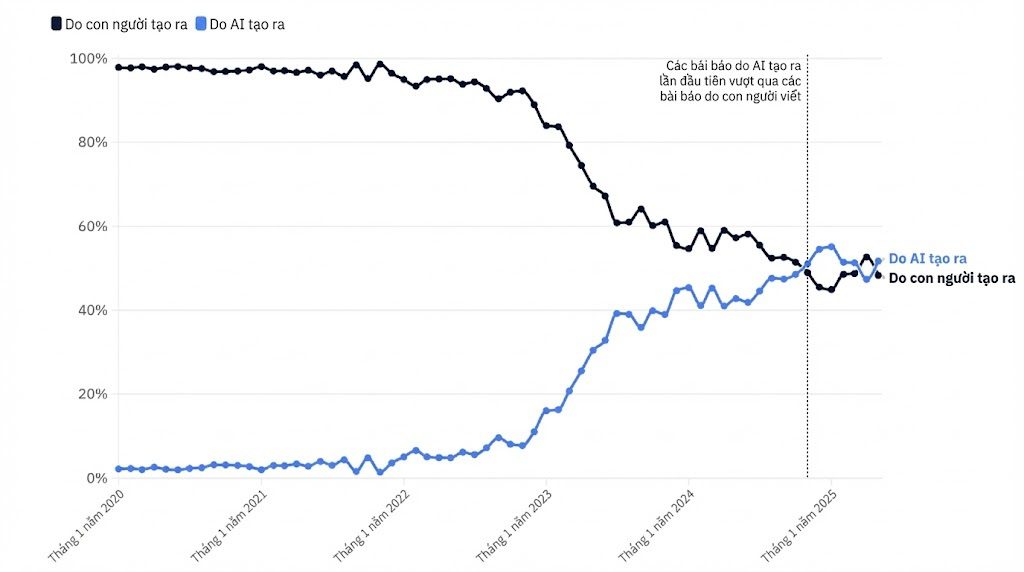
This is well founded, as statistics from Graphite.io show that by 2025 the volume of text on the internet produced by AI had matched, and sometimes exceeded, that written by humans. The internet faces the risk of saturation with artificial information, making the verification of information sources more important than ever.
Expert view: the future is collaboration
Although the risks are real, the potential of AI remains enormous if it is governed properly. In its latest white paper, the World Economic Forum (WEF) stresses that organisations need to change their mindset: treating AI agents as genuine collaborators rather than mere prediction tools.
At the same time, responsible use of AI not only reduces legal risks but can also help address macro-level problems, such as democratising financial advice or optimising energy systems to serve sustainable development goals.
Sources: Compiled from World Economic Forum reports, Statista and Goldman Sachs.