Accessing Google's most advanced AI models
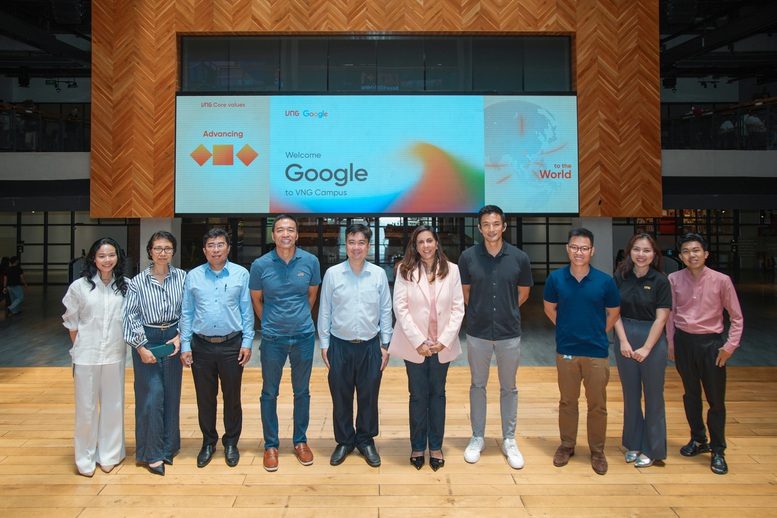
This partnership is the cornerstone of a shared commitment between Google, VNG Group, and VNUHCM to promote the development and application of AI in Vietnam. It enables the domestic research and innovation ecosystem to access Google's most advanced AI models, thereby creating AI solutions with high socio-economic value.
Under the cooperation framework, Google Labs' AI Futures Fund will work directly with research teams at SAIH, providing them with early, exclusive access to Google's latest technologies, along with direct technical support from experts at Google and Google DeepMind.
The AI Futures Fund is a global investment initiative launched by Google in early 2025 to accompany pioneering AI organizations at various stages of development. SAIH is the first research organization in Vietnam selected to participate in this program.
"By selecting Saigon AI Hub as the first partner for the Applied AI Lab experimental cooperation model, we are not just providing tools but together creating a conducive environment where Vietnamese researchers can bridge the gap between theoretical research and practical application," shared Josh Woodward, Vice President of Gemini Apps, Google Labs, and AI Studio.
Woodward also expressed his belief that the solutions developed here will not only benefit Vietnam but also provide valuable insights for the global AI research community.
Opportunity to apply the same technology simultaneously with the world's leading AI organizations
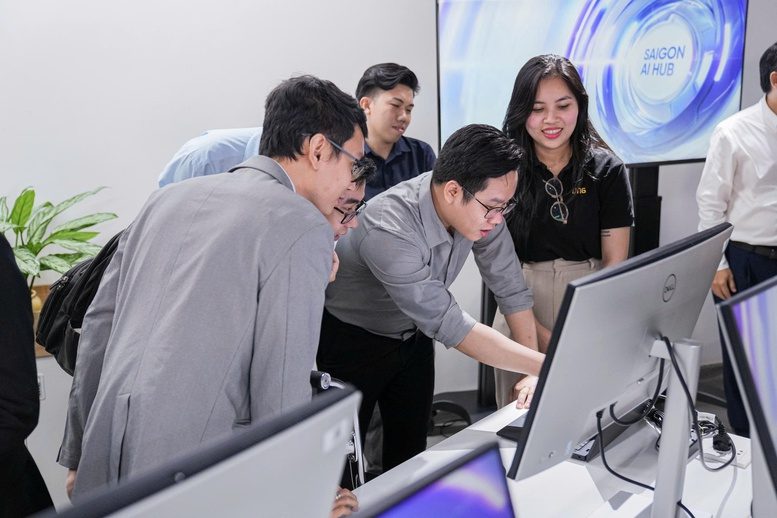
Emphasizing that the biggest barrier to AI research in Vietnam is not a lack of talent, Le Hong Minh, Founder and Chairman of VNG, stated that it is rather the lack of resources and supportive conditions for researchers to fully maximize their capabilities.
Through global partnerships like the one with Google Labs, researchers at SAIH and across Vietnam will have the opportunity to apply the same technology, at the same time, as the world's leading AI organizations. Therefore, this partnership is only the first step, and VNG expects to replicate this model with other AI research institutions in Vietnam, as well as with other global partners.
Announcing the first 10 research teams
In parallel with the Google Labs partnership, SAIH officially announced the first 10 research teams going into operation during this phase, bringing together nearly 60 researchers from universities in Ho Chi Minh City. The teams were carefully selected based on criteria of practical applicability, research capacity, and responsible AI development orientation, with topics spanning key areas including linguistics, computer vision, human-robot interaction, medical applications, and information security.
All teams are committed to publishing their research results in top-tier international conferences and journals (A*/A, Q1/Q2) while completing at least one prototype capable of practical application.
In addition to the current research teams, SAIH aims to become the premier destination for serious AI research in Vietnam. It provides essential resources such as infrastructure, expertise, and global partnerships—including potential capital investment from the AI Futures Fund—to enable research teams and startups to successfully develop products from prototypes. Interested researchers and teams can register to participate in subsequent phases of the program.
Vietnam is in a phase of vigorously promoting AI with the promulgation of the Artificial Intelligence Law and the National Strategy on AI to 2030. In this context, the partnership between Google Labs, VNG, and VNUHCM at Saigon AI Hub is expected to contribute positively to developing AI talent for Vietnam in the coming period, aiming to make Vietnam one of the leading AI and innovation hubs in ASEAN.
List of 10 research teams participating in Saigon AI Hub season 1:
| No. | Project | Description |
| 1 | Epistemically Disciplined Reasoning | Developing large language models with systematic reasoning capabilities that adhere to verifiable epistemic constraints, aiming to eliminate "hallucinations" and enhance reliability in argumentation. |
| 2 | Vietnamese Multimodal Emotion | Building a system that combines speech and text, optimized for the diverse tonal and dialectal characteristics of Vietnamese. |
| 3 | Multimodal Lifelog/Video Retrieval | Building an AI agent system that allows rapid searches in massive video archives using natural language, through both direct interaction and automated processing. |
| 4 | SoccerNet-VQA | Developing a multimodal model to solve complex visual reasoning and question-answering problems in professional soccer analysis. |
| 5 | Human–Robot Interaction (XR/MR) | Building a large language model application platform to support rapid prototyping and testing of robot behavior in highly realistic virtual and mixed reality environments. |
| 6 | Vn-SpeechMix | Solving the problem of isolating individual speakers in a multi-speaker environment, especially with various regional dialects in Vietnam, using deep learning. |
| 7 | AI for Cancer Detection | Enhancing early diagnosis capabilities for colorectal cancer through deep learning models that automatically segment polyps in clinical endoscopic images. |
| 8 | VR Story Train AI | Building an automated process to convert stories and text content into interactive and immersive 3D virtual reality environments. |
| 9 | Deepfake Detection | Developing digital forensic models capable of detecting edited or manipulated multimedia content, even in real-world conditions like blur, noise, or image compression. |
| 10 | Text-Guided Distractor Segmentation | Defining a new vision-language problem that automatically identifies and segments distracting objects, reducing focus away from the image's main subject. |